
How to use a router bit that's bigger than the opening in your router base
 I've read in your woodworking tool catalog that I can make raised panels with your big routers, but I saw a magazine article that said none of the models you sell have a bit opening big enough to fit the 3-1/2" bit I want to use. Do you actually have a router than can handle a router bit that big?
 In fact, all of our big variable-speed routers (12 amps and up) can handle the 3-1/2" bit you want to use. In one sense, the magazine article was right: a big bit won't fit through a small hole. When you put a panel-raising bit to work, however, you'll discover at once that the opening in the router base casting doesn't matter at all. It's the opening in your router table top that counts, because that's where the router bit actually lives and works. If you mount your router on a drop-in base 1/4" to 3/8" thick, the router bit never needs to be lowered far enough to touch the router base casting. In most cases it doesn't need to be lowered at all
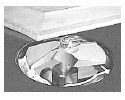 Panel raising bits generally have only a little more carbide height than the minimum needed to complete their profiles in 5/8" or 3/4" wood, so if you can house the bit as much as 1/8" deep within the table opening, you're ready to make straight raised panels. A very efficient way to work is to set the bit to its final depth of cut, then pull the fence 1/2" or so forward of the bit's ball bearing guide, thus limiting the first-pass load on the router just as effectively as setting a shallower depth of cut. Push the fence back flush with the bearing to complete the job.
Even when you do want to set intermediate depth for a first pass, such as when cutting panels with curved edges (when you can't use your fence to limit the width of cut), it's no problem. Setting the bit 1/4" to 5/16" deep within the insert opening allows a perfectly reasonable first pass. I've run 3-1/2" bits in routers with 2-5/8" base openings for many years, producing both straight and curved panels with no trouble at all. I use a table insert, whose 3/8" thickness is more than enough to handle any of the horizontal raised panel bits in our inventory.
So go ahead and order that big Triton plunge router with no worries about getting the job done. Don't forget to pick up a rail and stile set to go along with your panel raiser, too.
Zach Etheridge
Copyright © 2001 Highland Hardware