
Feather Boards
 Do you have a plan for making feather boards? I want to know what kind of wood to use, and how to cut the fingers so they're springy enough to hold my stock and prevent kickback, too.
 Springy fingers, eh? Interestingly enough, the amount of flexibility in a feather board is inversely proportional to its effectiveness; the springier the fingers, the less likely they'll control your stock when you really need them to. After all, if you want a piece of stock to remain in contact with a fence all the way through a cut (on the tablesaw, router table, or whatever), then you don't want fingers able to flex if the stock tries to move away from the fence, right? If you bend a feather board's very flexible fingers so strongly that they do provide reliable control, the pressure you've applied creates a great deal of friction, which is nothing but a drag. Of course, you can't apply any pressure at all in some situations—during a second pass of raised panel shaping, for instance, where pressure from above would push the panel down onto the bit. In such a case flexible feather boards are no help at all.
All right then, how about preventing kickback, you might ask. Well, since kickback results (one way or another) from loss of control over your work, positive control is a far better preventive measure than hoping that a bunch of polished, flexible wooden fingers will lock against a workpiece and arrest it after they've allowed kickback to begin.
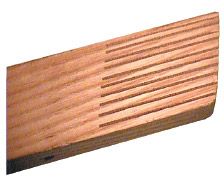 Given the foregoing, you won't be surprised that we recommend making quite stiff feather boards, with fingers that give very little so you can apply controllable pressure to your stock. Basically, we want performance as dependable as from a solid piece of wood, so that merely setting the fingers in contact with a workpiece will keep it positively under control. The feather board shown here is made from ash, though oak, maple, beech, birch or dogwood would work just as well. It's 2" wide, with the end cut at 20°. The fingers, cut on the bandsaw, average about 1/8" wide by 2" long. The infeed edge is radiused to allow smooth stock entry, and the ends of the fingers are waxed to keep friction to an unobtrusive minimum.
And of course, should you decide to forego making your own, we offer a few different varieties of feather boards for you to purchase.
Copyright © 2001 Highland Hardware, dba Highland Woodworking