
Routers Go Left!
How To use A Router
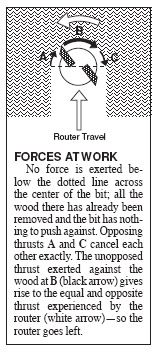 If you've just started using a router and find yourself uncertain about the right way to do it, or if like me you've taught yourself to use it in exactly the wrong way, then you are a prime candidate for my one-rule school of router technique. When I bought my first wood router I studied the manual for a minute or two and then went on to use the machine incorrectly in almost every situation. The problem was that I couldn't remember the list of specific instructions about what to do in this, that and every other application. Did they say move clockwise around inside edges and the other way around outside, or vice versa? Was I supposed to move the router from Here to There or from To to Fro? Simply guessing didn't suit me (I had a 50% chance of being wrong, after all), so I reasoned it out for myself and did it backward every time instead.
The trouble with rules is that there are too many of them. The wood router is the most versatile power tool in the shop, after all, doing a multitude of cutting, shaping and joinery operations. Memorizing a rule for every application would drive you nuts, and then you'd still be at a loss every time some new trick cropped up. It is possible, however, to determine quickly and easily how to use your router safely and well in almost any situation, thanks to that ancient fellow of apple-watching fame, Sir Isaac Newton. Who said, in his 3rd Law of Motion, that for every action there is an equal and opposite reaction. Applied to the router, Sir Isaac's law is translated thus: Routers Go Left!
The explanation is simplicity itself. Seen from above, the bit in a hand-held router rotates clockwise. As the bit pushes against the wood you're cutting, the wood pushes back and makes the router want to go the other way. This is always true no matter what kind of bit you're using, whether you're routing surfaces, inside or outside edges, and with or without jigs, fences or fixtures. Please note that the router goes to its left, which might or might not be your left. The long version of the First Law of Routers reads thus: Routers go left within their own frame of reference.
The router's inexorable urge to go left can be used to help control the tool in almost any routing situation. You can let the router push itself against a guide fence, pull a pilot bearing against an edge, hold a template guide snugly against a template, or push itself out of harm's way in freehand cutting. Knowing that the router always goes left lets you harness its behavior to achieve safe control and precise results with minimal effort. All you have to remember is one simple rule.
Using Router Fences
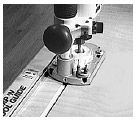
If you put a fence to the router's left, control is effortless and precision is virtually guaranteed as the router's urge to go left holds it against the fence.
Bearing-Guided Bits
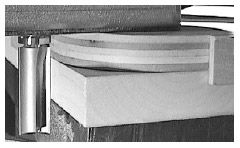
Move the router toward you, and it will pull the bearing tightly against the corner-rounding jig, trimming the workpiece cleanly and accurately. All you have to do is keep the router moving level.
Rabbeting a Router Table Top
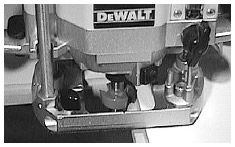
Here's another bearing-guided job. Push the router away from you and it will try to turn away from the edge of the opening, cutting a wavy and inaccurate rabbet. Pull it toward you, and the bearing stays tight and the rabbet comes out right.
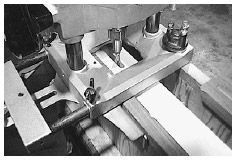
Tage Frid's Mortising Jig
Mortises are unbelievably accurate if you let the router pull its edge guide tight against the jig. Increase the depth of cut only at the left end of the mortise, then move the router toward the lower right corner of the picture. You don't even have to try to control the guide; the router does it for you.
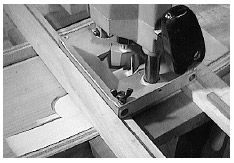
Frid Sculpting Jig
The stop on the sled rail at lower right kept the router under control during the first pass from right to left in the photo. The router returned to the right end of the jig along the same path, with no wood to cut and no fence to deal with. It was then moved to the right slightly less than the diameter of the bit for the next pass. During the second pass (shown partially completed) any lack of control would allow the router to go left into the area cut away by the first pass—and the router would simply stop as it pushed itself out of contact with the wood.
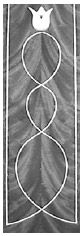
Freehand Routing
The smaller the bit, the lower the thrust it exerts against the router. The groove for the decorative stringing at left was cut with an 1/8" straight bit. Following the drawn pattern was as easy as tracing with a pen. The intricate design of the American Beauty Rose below was routed freehand with a 1/16" bit.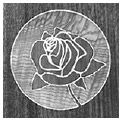
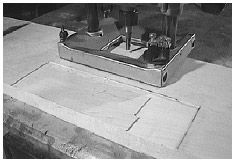
Freehand Hardware Mortise
This large, shallow mortise has been outlined fairly accurately with a 1/4" straight bit. Now the surface is being removed one pass at a time, leaving plenty of material for the router to ride on. Each wasting pass starts at the rear and moves to the front; as with the sculpting jig above, any momentary loss of control would allow the router to push itself into the wasted area, where it would cease to experience any reaction force and would simply stop.
Zach Etheridge
Copyright © 1998 Highland Hardware, dba Highland Woodworking